Showing posts with label 12 labors. Show all posts

Saturday, March 2, 2013

The Erymanthian Boar's Capture (4th Labor)

Sophocles, Trachinae 1097 (Greek tragedy C5th B.C.): 
 "You [Herakles] tamed the beast in Erymanthia." 

 The capture of the Erymanthian Boar was Herakles' fourth Labor. This boar wasn't Babe. It was giant, quick and deadly. Not only did it have dangerous tusks (the death of Adonis shows how deadly these can be), but it was prone to rages. It had been raging and destroying the fields of Psophis in western Arcadia. This region was a favorite haunt of Artemis and tended to be more remote and wild. People were afraid of the boar and wanted it gone. Herkales set out to capture it. And capture, not kill, because Eurystheus wanted to make the task all the more difficult.


Herkales made his way to Mount Erymanthus in Arcadia, where the boar was known to roam. On the way he decided to visit Pholus. Pholus was a centaur, son of Ixion, and friend of Herakales. He gave shelter, food and company to Herkales. They shared a meal and Herakles noticed some wine and asked Pholus for a drink. Pholus told him he old had one jar and it was a gift from Dionysos to the centaurs of Mt. Erymanthos. Herakles convinced Pholus to open it and the smell of wine drew the centaurs to the area. Some retellings say that the centaurs got drunk off the wine first and others say that were merely angry at the perceived violation of their gift from Dionysos. Either way, the other centaurs attacked Herakles. He launched poisoned arrows at them, but they retreated within Chiron's (his old mentor) cave.

Pholus was curious about the arrows and picked one up, inadvertently poisoning himself when he dropped it and it stabbed him in the hoof. Chiron was also hit, most accounts say by a stray arrow, and was poisoned. Since Chiron was immortal he didn't die, but lived with terrible pain and agony. Later, he'd give up his immortality and became a constellation in the sky.

Though most tellings don't delve into Herakles' thoughts and feelings, one can only imagine how bad he felt. Two friends, kind centaurs were killed due to his foolish and unthinking actions. I can imagine him thinking, if only I didn't open the wine! After this incident he decided to continue on with his task of capturing the boar.

Using the advice Chiron gave him, Herkales chased the boar into the mountain snow to weaken and tire it. Eventually he was able to get an upper-hand on the beast and trapped it with ropes or a net. He then bound the animal and started his journey back to Mycenae.

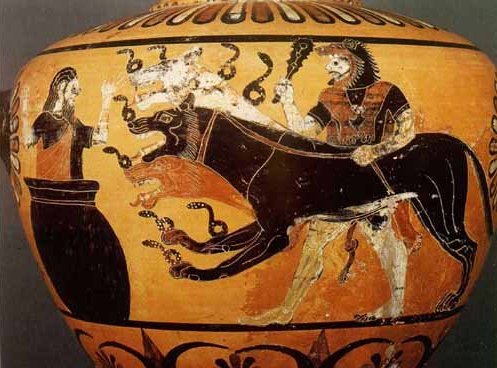
When he got to the palace of Eurystheus, the king was terrified and as he did with the Capture of Kerberos, he hide in or behind a pithos jar. Eurystheus then ordered Herakles to be rid of the beast, which Herakles did. Some accounts say he threw it into the ocean.

This Labor, out of the ones I've covered so far seems different. Perhaps it's the diversion with the centaurs? Herakles decided to take a breather for a bit, but it failed miserably. He pissed off the centaurs, which lead to the deaths of his two friends. Seems like Herakles can't catch a break. After this, he's wading in shit (literally) in the Augean  Stables, but more on that soon!


Pantheon.org
Wikipedia
Theoi
The Erymanthean Boar

Saturday, February 25, 2012

Descending into Hades to Capture Kerberos (12th Labor)

I was going to write about Herakles' death for this "d," but I wanted to have time to ponder it all. I'll be writing about his death and Deïanira (another possiblity I thought of) soon. This time I'm going to look into Herakles' 12th and last labor, perhaps the most dangerous one of all.


Kerberos (Cerberus) is the three-headed (though sometimes fifty or one-hundred headed) hound who guards the gates of Hades, making sure the shades entered the Underworld, but never escaped back into the world of the living. He's the son of Typhaon and Echidna, who are also the parents of the Hydra, which Herakles killed previously. Kerberos has a number of descriptors. He's called dreaded hound (deinos kunos), jagged-toothed, with no pity, unspeakable, unmanageable, savage, powerful, bronze-barking, fierce, etc. Kerberos was not something you'd want to mess with, that's for sure. Eurystheus must have thought this Labor was the one out of all the others that would leave Herakles unsuccessful. After all, how could a mortal enter into Hades and return, not only with their life, but with Kerberos? It seemed impossible. One only entered Hades by dying (with a few exceptions, like Orpheus) or if they were a god. Herakles was determined not to fail and set out to complete this Labor.

To prepare himself for the journey into Hades, he became an initiate into the Eleusinian Mysteries. Herakles participated in the Lesser Mysteries, which included him being cleansed of the guilt from slaughtering the Centaurs. I plan on researching Herakles role in the Mysteries at a later time, but for now, all we need to know was he was initiated and cleansed. I don't know how long this took, but it was a necessary step. After this, Herakles was ready to enter Hades.

He chose to enter as one would enter as a god and hero (as dying wasn't an option), using various caves, chasms and entrances. The most common location given for Herakles' descent into Hades is a cave in Tainaron, Laconia (where Orpheus entered). Today it's known as Cape Tainaron or Cape Matapan. It's the southern most point of mainland Greece and has long been held as an entrance into the Underworld. He is accompanied and helped with this dangerous feat by Hermes and Athene, who help him traverse the Underworld.
Homer, Odyssey 11. 623 ff (trans. Shewring) (Greek epic C8th B.C.) :
"[The ghost of Herakles addresses Odysseus in Hades:] ‘He [Eurystheus] once sent me even here [to Haides] to fetch away the hound of Haides, for he thought no task could be more fearsome for me than that. But I brought the hound out of Haides' house and up to earth, because Hermes helped me on my way, and gleaming-eyed Athene.’"
Like everyone who entered Hades, he needed to cross the river Styx and to do this he needed to be ferried by Kharon (Charon). This was a problem as Kharon required one to be dead and to give payment (a coin usually placed under the tongue of the dead provided this). Herakles met neither requirement, but this wasn't about to stop him from completing his mission. Accounts aren't detailed, but some say Herakles overpowered Kharon with strength and managed to cross the Styx. A few places mention, for this, Kharon was punished by Hades by chaining him to his oar for a year!

Once in Hades, he saw the usual sights-- shades. He saw Meleager, a hero who recently died and he asked Herakles to do him a favor and marry his sister, Deïanira. Herakles vowed that he would. Deïanira would play an important role later on, with Herakles' death, but I'll save that tale for another time!

Some shades were frightened of him (it must have been odd, seeing a living person down there) and fled. While he was down there he saw Theseus, a fellow hero and friend, and Pirithous, king of the Lapiths (Theseus' companion). Both of them were being punished by Hades for attempting to abduct Persephone. See, Theseus and Pirithous wanted to marry daughters of Zeus and set out to claim their picks. Theseus chose Helen and managed to abduct her (though she was rescued by The Dioskouri, her brothers). Pirithous wanted Persephone and both of them traveled into Hades to find her. When they were in the outskirts of Tartarus, Theseus sat down on a rock and found that he couldn't move. He was frozen in place as was Pirithous. Around them Furies punished them. For many months they were in darkness, doomed. Herakles came upon them and set out to free them. He managed to get Theseus free, either by appealing to Persephone or by sheer strength (removing him from the rock). Pirithous was not so lucky, as when Herakles tried to remove him from the rock, the earth violently shook. Herakles left Pirithous to his fate, not wanting to anger Hades further. Theseus would go on to return to Athens and continue on his journeys.

Herakles also fought with Hades' cowheard, Menoetes, after Herakles killed one of the cattle to use to talk to the dead (via blood sacrifice).  Herakles would have killed him if Persephone didn't come to Menoetes' rescue.

Heracles & Cerberus, Francisco De Zurbaran, 1634
After all this, Herakles entered the next phase of his task, meeting Hades himself. Most accounts add the meeting of Hades, though some don't mention it. This meeting must have been an interesting one! But what we know of it is little, only that Herakles asked Hades if he could take Kerberos with him to complete the task. Some say Hades was pissed to find a mortal trespassing and that Persephone pleaded with Hades to give Herakles permission to capture his hound. Surprisingly, Hades allowed it provided Herakles didn't use any weapons and returned the hound (alive). Hades must have thought this would be very difficult, if not impossible. Remember all those descriptors for Kerberos? He wasn't a nice doggy!

Herakles finally gets to Kerberos and the fight begins. It was dangerous one. Kerberos' barbed and poisonous tail tried to pierce Herakles' flesh, but his trusty lion pelt warded off the attack. He tried to rip and bite at his flesh with his three heads. Eventaully, Herakles managed to get the hound by the throat, choking him. Kerberos yielded and was bound with unbreakable chains.

Aconitum napellus
One side myth I came across was that from Kerberos' saliva that dripped to the ground sprung a plant called Aconite. It was a poison and later Medea would use it to in an attempt to poison Theseus. It was called akoniton because it grew without dirt, in barren areas. Hekate also used the plant/poison. It's a pretty plant!

Herakles, with Kerberos chained, drags the hound out of the entrance to Hades into the land of the living. It must have been a weird experience for Kerberos-- to be out of Hades, to be surrounded by weird things and all things living. If the fight with Herakles didn't put him into submission, I would think the shock of the new environment did! Herakles alternately drags Kerberos or carries him slung over/around his shoulders. Hermes and Athene are also said to accompany him as he leaves Hades and enters the land of the living once more. Some add that Persephone was there as well, to see to the task.

Herakles and the hound make it back to Tiryns where he presents the Hound of Hades to Eurystheus. I found a vase painting of this scene. It's funny! Eurystheus hides in a pithos (storage jar) at the sight of the hound. I can't laugh too much at this though, because in his place, I probably would have hid myself! No one expected Herakles to enter into Hades and return alive and with Kerberos. Eurystheus was so freaked out he wanted the hound returned immediately. Herakles, already knowing he had to return the hound complied and went back to the Underworld to return him. With this capture of Kerberos, Herakles was finally finished with his Labors.

I thought this was an interesting quote that tries to get into Hera's head after witnessing this--
Seneca, Hercules Furens 46 ff (trans. Miller) (Roman tragedy C1st A.D.) :
"[Hera complains of Herakles:] ‘Nor is earth vast enough for him [Herakles]; behold, he has broken down the doors of infernal Jove [Haides], and brings back to the upper world the spoils of a conquered king [i.e. the hound Kerberos]. I myself saw, yes, saw him, the shadows of nether night dispersed and Dis [Haides] overthrown, proudly displaying to his father [Zeus] a brother's spoils. Why does he not drag forth, bound and loaded down with fetters, Pluto [Haides] himself, who drew a lot equal to Jove's? Why does he not lord it over conquered Erebus and lay bare the Styx? It is not enough merely to return; the law of the shades has been annulled, a way back has been opened from the lowest ghosts, and the mysteries of dread Death lie bared. But he, exultant at having burst the prison of the shades, triumphs over me, and with arrogant hand leads through the cities of Greece that dusky hound. I saw the daylight shrink at sight of Cerberus, and the sun pale with fear; upon me, too, terror came, and as I gazed upon the three necks of the conquered monster I trembled at my own command.’"
*

With the Labors complete, Herakles was no longer bound to Eurystheus and was free to go on other adventures. More on that later!

I was planning on writing my thoughts, but this took longer than I expected to write! I'll come back later and add my impressions. :-)

Sites of Interest:
Wiki: Cape Matapan
Eleusinian Mysteries
Wiki: Theseus in Hades
Wiki: Cerberus
Capture of Cerberus
Theoi: Kerberos

Saturday, February 18, 2012

Capture of the Cretan Bull (7th Labor)

(Just going back and completing my missing "c" for the PaganBlogProject!)


The Cretan Bull, Herakles' seventh labor, has an interesting mythology of its own. For a little back-story...

Desiring to ascend to the throne, Minos prayed to Poseidon to send him a bull as proof of his approval. Poseidon heard his prayer and sent him a magnificent, white bull out of the sea with the understanding that Minos would sacrifice it to him in return. Minos didn't. At the sight of this beautiful bull he decided to sacrifice another one in its place, thinking Poseidon wouldn't mind. He was wrong. Poseidon was angry. Poseidon decided to do something unusual, he made Minos' wife, Queen Pasiphaë, fall madly, passionately in love with the bull. She lusted after it so badly, she had Daidalos construct a wooden cow that Pasiphaë could enter to make copulation with the bull possible. Out of this bestiality came the monstrous Minotaur. After this incident, Minos wanted nothing to do with the bull.

Eurystheus told Herakles to capture the Cretan Bull, who was now causing havoc on Crete. It was wild, and trampled on crops, etc. Herakles set off to Crete and when he finally got there, Minos offered aid to catch the bull. Herakles refused help, but Minos gave him permission to take the bull, which made things easier. He was no doubt glad someone would be taking it off his hands! Herakles managed to catch the bull using a lasso, strength and some sort of bull-whispering that made the bull submit to him. He took the bull to Mycenae either by riding on its back all the way to the palace of Eurystheus or by carrying it over his shoulders, placing it on a boat and sailing there.

Eurystheus, apparently hid in a pithos (large storage jar) at the sight of the bull. I'm not sure why (LOL), though I supposed he hadn't seen the Mares of Diomedes yet (that'd come next), which would have made me freak out! Eurystheus wanted to sacrifice it to Hera, but she didn't want it. The Cretan Bull was let loose and allowed to run free. Eventually it reached the plains of Marathon where it became the Marathonian Bull. It caused trouble there too.

Later, the Cretan/Marathonian Bull would be killed by another hero (Theseus), who would also killed the bull's son, the Minotaur. Mythology also indicates that the bull was raised to the heavens to become a constellation (Taurus). My name (not my real name, but the one I use on the internet) is also a name for a star in the Pleiades, Asterope aka 21 Tauri. :-)

I have no idea how long a boat journey from Tiryns to Crete would have taken, but I was curious and put the places into Google Maps. They're not exact, but it came up with a general start to finish with 317 miles and a estimated time of 9 hours. And that's with a ferry. I'm assuming it'd take a lot longer than that for Herakles! That's one thing that stands out to me with these Labors, how time consuming they are. For some reason I imagined them happening one after the other, banged out and done with, but really, when you think about it there's a lot of time lost in completing them. There's time to travel (by animal, chariot or foot) to the destination, the time it takes to compete the task itself as well as the time to return to Eurystheus to report in and receive the next task. To capture the Hind alone took a year. Some of the others must have taken a long time as well. Most people wouldn't have that sort of focus, patience and determination, but Herakles stuck with it! It's pretty admirable, I think. :-)


Sites of Interest:
Wikipedia: Cretan Bull
Theoi
Encyclopedia Mythica
Timeless Myths: Cretan Bull

Friday, February 17, 2012

Diomedes' Mares (8th Labor)

For "d" I decided to look into the Mares of Diomedes. I just finished reading various accounts and this is what I've learned---


The capture of the Mares of Diomedes was Herakles eighth labor, following the capture of the Cretan Bull. Eurystheus told Herakles to capture the four mares of Diomedes, a giant and son of Ares and Kyrene (he was also the king of the Bistones in Thrace). These mares were savage and uncontrollable (just like their master) and man-eating. Lovely! Instead of eating hay and nibbling on succulent grasses, these mares were eating people (strangers, specifically) Diomedes fed them. Because of this unnatural diet they became crazy. They were so dangerous they weren't allowed to roam free, instead they had to be tethered and kept in sables. They couldn't be held by regular rope and instead were chained with bronze and in some accounts, in a bronze manger. Geez!

Herakles decided to take some companions, though only one seems to get singled out and named. He was Abderus ("son of battle"), son of Hermes. They went to the palace of Diomedes (which was near the Black Sea) and Diomedes, who had no idea who they were, thought he had some horse-food. To him, Herakles was just another stranger, a meal for his bloodthirsty mares. Herakles got into a wrestling match with Diomedes, which some accounts say went on for some time as they were pretty evenly matched. Abderus was left in charge of watching over the horses while Herakles dealt with Diomedes. This was an error. The mares turned on Abderus and he became dinner. This part seems to differ in myths. Some say he died first, before Herakles captured them and some say after. Either way, Abderus dies and Herakles is saddened and pissed.

Herakles gains the upper-hand and wins the wrestling match, no doubt suprising Diomedes. Being the son of Ares, this had to be a blow to his ego. After this wrestling match, Herakles gets Diomedes to the stables where he feeds the murderous mares their own master. Accounts say he was eaten alive. Ha! That had to suck. After this meal the mares calm down. It seems feeding them the flesh and blood of their master was a sort of antidote. It snapped them out of their insanity and now they became manageable. Herakles takes the mares and heads back to Eurystheus, though before he goes he gives his friend Abderus a worthy burial and founded a city (Abdera, Thrace) in his name. Athletic games were held in his honor, except for chariot races, it seems, out of honor for his death by horse.

Eurystheus was probably expecting savage mares, but when Herakles presented them to him they were quite calm. Eurystheus dedicated these mares to Hera, but she refused them. Once account said because they reflected Herakles glory and she didn't want to have anything tainted with that. So, they were let to roam in Argos where some were killed. At least one survived because it was said that Alexander the Great's beloved horse Bucephalus was said to be their descendent.

This Labor doesn't have the wow factor to me as the Ceryneian Hind, as that one required him to hunt the hind for a year and deal with Artemis. It's still a great feat though, as mythology indicates these mares were wild and savage...they sound like rabid, feral beasts, not mares. Honestly, these mares sound creepy. I could imagine them foaming at the mouth, with blood and bits of flesh at the muzzle. Very creepy.

This Labor does stand out because (and I've only read about this one and the Ceryneian Hind so far, so my scope is limited at the moment) he brought companions and one of them died. This no doubt added to his already huge weight of guilt. Even though I already wrote my Adorations, the descriptor of "founder of cities" came to mind. I just might have to add it. I wonder how many other cities he personally founded. I'm sure I'll find out!


Sites of Interest:
Enyclopedia Mythica
Wikipedia: Abdera, Thrace
Wikipedia: Mares of Diomedes
Wikipedia: Diomedes of Thrace
Wikipedia: Abderus 
Theoi

Wednesday, February 15, 2012

Capture of the Ceryneian Hind (3rd Labor)


Since I'm on "c" now I thought I'd look into the capture of the Ceryneian Hind (the third labor). This hind was said to be larger than a bull and was sacred to Artemis. It had golden antlers and bronze hooves. It was super fast and was said to be able to outrun an arrow in flight. It seems she intended for it to be part of her chariot, but it escaped and was left to wander. Or as another version goes, it was a gift from the nymph Taÿgete (or Taÿgete herself transformed).

Pissed that Herakles completed his previous tasks (Nemean Lion & Hydra) without dying, Eurystheus and Hera thought they'd stop him in his tracks with this task. They knew he could kill monstrous beasts, but could he catch something so fast (and alive)? And what of Artemis' wrath, could he survive that? They didn't think so...

Myth varies on how he caught the hind, but most sources I've read say he chased the deer for a year (or more) all over the place, through Greece, Thrace, and even as far north as Hyperborea. Some accounts I read said the hind grew tired and took a rest by a river and others say the hind never tired and Herakles realized he needed to take action (or he could be chasing her forever). Either way, as the hind stopped for a drink at a river, Herakles took an arrow and shot it at the deer. He aimed for the hoof region so as not to kill the animal as he only wanted to incapacitate her long enough for capture. And capture her he did!

He took this hind and started on the long journey back to Mycenae, but on the way he ran into trouble. Artemis (and Apollo some add) saw Herakles with her sacred hind captured and became angry. Herakles explained his situation and pleaded with the goddess and promised to return the hind. In the end she understood and allowed him to take the hind back to Mycenae, where she was brought alive to Eurystheus. Eurystheus wanted to add the hind to his collection, but remembering his promise to Artemis, Herakles knew that couldn't happen. He told Eurystheus to get the hind himself. Eurystheus was too slow, the hind too quick and escaped, running back to Artemis. Herakles kept his promise to Artemis, avoided her wrath and completed his third labor. All of this vexed Eurystheus and Hera greatly and they went out to think up another labor...

I had no idea some of these labors were so time consuming! Imagine chasing after a deer for over a year. That takes a lot of dedication, patience and persistence! 


Links of Interest:
Theoi
Wikipedia
Encyclopedia Mythica