Monday, February 27, 2012

Dynastes hercules -- The Hercules Beetle

Not only is there a moth named after Herakles, but a beetle. It's a type of Rhinoceros Beetle, native to Central and South America. These types of beetles are among the largest in the world.

Here's a video of two males dueling during mating season:

And here's one just chilling on a rock: 


Random facts I've found about them:
  • Mating can last up to 50 minutes
  • They live as larvae underground for 10-16 months and only 3-4 months as adults above ground
  • "Pound for pound, Hercules beetles are the strongest animal in the world. Some can lift as much as 850 times their own weight" 1
  • They're omnivorous and have a "sweet-tooth" for fruits

And according to Wiktionary, Dynastes means, "a ruler, prince." 2

Sites of Interest:
1 Hercules Beetle 
YouTube Video: Hercules Beetle
Hercules Beetle
Hercules Beetles
Tons of Pics
2 Wiktionary entry
Wiki

Saturday, February 25, 2012

To Herakles 1

 As I said a few days ago, I wanted to write at least one hymn/prayer before the 4th day of the (Greek calendar) month. I kept trying to write the most awesome, perfect hymn/prayer, but that's what kept tripping me up. I laxed my expectations and just let things flow. Here's the result ---


Hail Herakles!
Guardian, Protector--
Glorious son of Loud-Thundering Zeus
I honor you--
Who completed the Labors,
Never retreating from a task
With determination and courage
You triumphed!
Herakles, mighty warrior
Hero-God of all of Greece,
Defender and Deliverer
Hear my prayer!  


-- Asterope

Descending into Hades to Capture Kerberos (12th Labor)

I was going to write about Herakles' death for this "d," but I wanted to have time to ponder it all. I'll be writing about his death and Deïanira (another possiblity I thought of) soon. This time I'm going to look into Herakles' 12th and last labor, perhaps the most dangerous one of all.


Kerberos (Cerberus) is the three-headed (though sometimes fifty or one-hundred headed) hound who guards the gates of Hades, making sure the shades entered the Underworld, but never escaped back into the world of the living. He's the son of Typhaon and Echidna, who are also the parents of the Hydra, which Herakles killed previously. Kerberos has a number of descriptors. He's called dreaded hound (deinos kunos), jagged-toothed, with no pity, unspeakable, unmanageable, savage, powerful, bronze-barking, fierce, etc. Kerberos was not something you'd want to mess with, that's for sure. Eurystheus must have thought this Labor was the one out of all the others that would leave Herakles unsuccessful. After all, how could a mortal enter into Hades and return, not only with their life, but with Kerberos? It seemed impossible. One only entered Hades by dying (with a few exceptions, like Orpheus) or if they were a god. Herakles was determined not to fail and set out to complete this Labor.

To prepare himself for the journey into Hades, he became an initiate into the Eleusinian Mysteries. Herakles participated in the Lesser Mysteries, which included him being cleansed of the guilt from slaughtering the Centaurs. I plan on researching Herakles role in the Mysteries at a later time, but for now, all we need to know was he was initiated and cleansed. I don't know how long this took, but it was a necessary step. After this, Herakles was ready to enter Hades.

He chose to enter as one would enter as a god and hero (as dying wasn't an option), using various caves, chasms and entrances. The most common location given for Herakles' descent into Hades is a cave in Tainaron, Laconia (where Orpheus entered). Today it's known as Cape Tainaron or Cape Matapan. It's the southern most point of mainland Greece and has long been held as an entrance into the Underworld. He is accompanied and helped with this dangerous feat by Hermes and Athene, who help him traverse the Underworld.
Homer, Odyssey 11. 623 ff (trans. Shewring) (Greek epic C8th B.C.) :
"[The ghost of Herakles addresses Odysseus in Hades:] ‘He [Eurystheus] once sent me even here [to Haides] to fetch away the hound of Haides, for he thought no task could be more fearsome for me than that. But I brought the hound out of Haides' house and up to earth, because Hermes helped me on my way, and gleaming-eyed Athene.’"
Like everyone who entered Hades, he needed to cross the river Styx and to do this he needed to be ferried by Kharon (Charon). This was a problem as Kharon required one to be dead and to give payment (a coin usually placed under the tongue of the dead provided this). Herakles met neither requirement, but this wasn't about to stop him from completing his mission. Accounts aren't detailed, but some say Herakles overpowered Kharon with strength and managed to cross the Styx. A few places mention, for this, Kharon was punished by Hades by chaining him to his oar for a year!

Once in Hades, he saw the usual sights-- shades. He saw Meleager, a hero who recently died and he asked Herakles to do him a favor and marry his sister, Deïanira. Herakles vowed that he would. Deïanira would play an important role later on, with Herakles' death, but I'll save that tale for another time!

Some shades were frightened of him (it must have been odd, seeing a living person down there) and fled. While he was down there he saw Theseus, a fellow hero and friend, and Pirithous, king of the Lapiths (Theseus' companion). Both of them were being punished by Hades for attempting to abduct Persephone. See, Theseus and Pirithous wanted to marry daughters of Zeus and set out to claim their picks. Theseus chose Helen and managed to abduct her (though she was rescued by The Dioskouri, her brothers). Pirithous wanted Persephone and both of them traveled into Hades to find her. When they were in the outskirts of Tartarus, Theseus sat down on a rock and found that he couldn't move. He was frozen in place as was Pirithous. Around them Furies punished them. For many months they were in darkness, doomed. Herakles came upon them and set out to free them. He managed to get Theseus free, either by appealing to Persephone or by sheer strength (removing him from the rock). Pirithous was not so lucky, as when Herakles tried to remove him from the rock, the earth violently shook. Herakles left Pirithous to his fate, not wanting to anger Hades further. Theseus would go on to return to Athens and continue on his journeys.

Herakles also fought with Hades' cowheard, Menoetes, after Herakles killed one of the cattle to use to talk to the dead (via blood sacrifice).  Herakles would have killed him if Persephone didn't come to Menoetes' rescue.

Heracles & Cerberus, Francisco De Zurbaran, 1634
After all this, Herakles entered the next phase of his task, meeting Hades himself. Most accounts add the meeting of Hades, though some don't mention it. This meeting must have been an interesting one! But what we know of it is little, only that Herakles asked Hades if he could take Kerberos with him to complete the task. Some say Hades was pissed to find a mortal trespassing and that Persephone pleaded with Hades to give Herakles permission to capture his hound. Surprisingly, Hades allowed it provided Herakles didn't use any weapons and returned the hound (alive). Hades must have thought this would be very difficult, if not impossible. Remember all those descriptors for Kerberos? He wasn't a nice doggy!

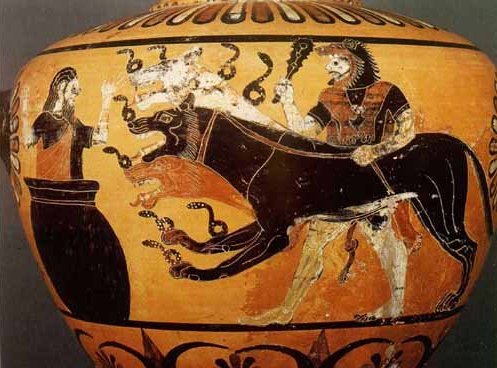
Herakles finally gets to Kerberos and the fight begins. It was dangerous one. Kerberos' barbed and poisonous tail tried to pierce Herakles' flesh, but his trusty lion pelt warded off the attack. He tried to rip and bite at his flesh with his three heads. Eventaully, Herakles managed to get the hound by the throat, choking him. Kerberos yielded and was bound with unbreakable chains.

Aconitum napellus
One side myth I came across was that from Kerberos' saliva that dripped to the ground sprung a plant called Aconite. It was a poison and later Medea would use it to in an attempt to poison Theseus. It was called akoniton because it grew without dirt, in barren areas. Hekate also used the plant/poison. It's a pretty plant!

Herakles, with Kerberos chained, drags the hound out of the entrance to Hades into the land of the living. It must have been a weird experience for Kerberos-- to be out of Hades, to be surrounded by weird things and all things living. If the fight with Herakles didn't put him into submission, I would think the shock of the new environment did! Herakles alternately drags Kerberos or carries him slung over/around his shoulders. Hermes and Athene are also said to accompany him as he leaves Hades and enters the land of the living once more. Some add that Persephone was there as well, to see to the task.

Herakles and the hound make it back to Tiryns where he presents the Hound of Hades to Eurystheus. I found a vase painting of this scene. It's funny! Eurystheus hides in a pithos (storage jar) at the sight of the hound. I can't laugh too much at this though, because in his place, I probably would have hid myself! No one expected Herakles to enter into Hades and return alive and with Kerberos. Eurystheus was so freaked out he wanted the hound returned immediately. Herakles, already knowing he had to return the hound complied and went back to the Underworld to return him. With this capture of Kerberos, Herakles was finally finished with his Labors.

I thought this was an interesting quote that tries to get into Hera's head after witnessing this--
Seneca, Hercules Furens 46 ff (trans. Miller) (Roman tragedy C1st A.D.) :
"[Hera complains of Herakles:] ‘Nor is earth vast enough for him [Herakles]; behold, he has broken down the doors of infernal Jove [Haides], and brings back to the upper world the spoils of a conquered king [i.e. the hound Kerberos]. I myself saw, yes, saw him, the shadows of nether night dispersed and Dis [Haides] overthrown, proudly displaying to his father [Zeus] a brother's spoils. Why does he not drag forth, bound and loaded down with fetters, Pluto [Haides] himself, who drew a lot equal to Jove's? Why does he not lord it over conquered Erebus and lay bare the Styx? It is not enough merely to return; the law of the shades has been annulled, a way back has been opened from the lowest ghosts, and the mysteries of dread Death lie bared. But he, exultant at having burst the prison of the shades, triumphs over me, and with arrogant hand leads through the cities of Greece that dusky hound. I saw the daylight shrink at sight of Cerberus, and the sun pale with fear; upon me, too, terror came, and as I gazed upon the three necks of the conquered monster I trembled at my own command.’"
*

With the Labors complete, Herakles was no longer bound to Eurystheus and was free to go on other adventures. More on that later!

I was planning on writing my thoughts, but this took longer than I expected to write! I'll come back later and add my impressions. :-)

Sites of Interest:
Wiki: Cape Matapan
Eleusinian Mysteries
Wiki: Theseus in Hades
Wiki: Cerberus
Capture of Cerberus
Theoi: Kerberos

Thursday, February 23, 2012

Painting: The Choice of Hercules

I'm planning on posting my second "d" entry for the PaganBlogProject soon, but until that's completed, here's a piece of art --


The Choice of Hercules 
Annibale Carracci, 1596
 

"...A vigorous and plastic Hercules is depicted with two women flanking him, who represent the opposite destinies which the life could reserve him: on the left the Virtue is calling him to the hardest path leading to glory through hardship, while the second, the Pleasure, the easier path, is enticing him to the vice.


Behind Hercules is a palm, which, through the leaves and the branches (a symbol of military victory and fame), hints to Hercules' future heroic life." (source)

Wednesday, February 22, 2012

Interesting... Herakleia Nosos?

I came across this--
Herakleia nosos, morbus herculeus, mal d'hercule - epilepsy has been known as the 'Hercules sickness' for over 2000 years. This name for the disease originates from the opinion that the demigod Hercules, the son of the god Zeus and the human Alcmene, suffered from epilepsy. The 'proof' of this is always stated to be the part in the fifth main scene of Euripides' play Hercules furens, in English Madness of Heracles, where Hercules (who is just about to bring Zeus an expiatory sacrifice) is described with the following words:

'And everyone looks at the man who has been struck dumb and is completely changed, whose reddened eyes roll, from whose beard froth drips... He bears his body and struggles to breathe'...
(Source)
Did not know this! I had no clue Herakles was associated with epilepsy. It doesn't makes sense to me, though, as an explanation for his madness. And a play is not enough proof for me to latch onto the idea. I know those with complex partial seizures have their consciousness altered, but they don't go homicidal and crazy. Many may make automatisms (lip smacking, repetitive movements, etc), but...it doesn't really fit Herakles. Also, while people can have seizures (from injury, fever, Rx, etc) and not have epilepsy, to say Herakles was epileptic implies he had recurrent seizures (and if alive today, would have been put in Rx to control them), which doesn't fit with mythology and what we know of his life. Interesting, though, how mythology weaves itself into so many facets of our lives.

Tuesday, February 21, 2012

Writing Hymns, Having Dreams & Other Things

Some gods have a lot of hymns-- Apollo, Aphrodite and Artemis come to mind. Others don't have so many. Herakles has an Orphic hymn and a Homeric hymn. The Homeric hymn isn't too bad, though it seems more like an intro to a longer hymn, than one all on its own. To me at least! The Orphic hymn confuses me. Herakles is mentioned to be a Titan and father of Time (Kronos, basically), which doesn't make sense. I know Herakles was an initiate in the Eleusinian (Lesser?) Mysteries, but I'm not yet knowledgeable about the details of this, or his possible roles in Orphism or other Mysteries. I'll have to look into this, eventually.

Anyway, due to the lack of hymns for Herakles, I decided to write my own. It's goal of mine. I'm hoping to have one done by the 26th. According to the Hellenion calendar, noumenia (the first of the month) is on the 23rd. According to sources Herakles, Eros and a few others were honored on the fourth day of the month. That would be the 26th. (Unless I'm totally misunderstanding things!) Anyway, I'd like to have something written by the 26th so I can use it. I have a few things penned down, but nothing solid. It's harder than I thought it'd be. LOL. Perhaps when I get to know him on a more personal level, things will be easier.

*

I've been finding some articles (scholarly ones) about Herakles to read and when the time comes, write about. I have:
  • Hercules and the Triumphal Feast for the Roman People - Annalisa Marzano
  • Herakles' Attributes and Their Appropriation by Eros S Woodford
  • Herakles and the Eleusinian Mysteries - Daniela Colomo   
  • Domestic Statuary at Pompeii, The Sculptural Repertoires of Venus, Hercules, and Dionysus - Allison R. Kennedy 
  • Herakles in Attic vase-painting of the Peisistratean period - John A. Tamm
  • I also found an article about Mithras (I can't recall the title) that mentions a link between Herakles (or Hercules, Roman) with Mithras.  (I've had along time interest in Mithra/Mithras, so the article was of interest in that regard as well)
 *

Also, I've had these sort of hazy (and not so hazy) dreams about Herakles lately. Some of them are about the Labors. I remember a few days ago, dreaming of him hunting the Hind in the forest and chasing the golden glint of her antlers. It was always just out of reach! And in another I had this vivid image (or scene?) of him covered in blood (kneeling), in shock and crying/yelling to the heavens, only to have a thunderstorm answer and rain wash away the blood from his hands. That one stuck with me. I know of his madness and murder of his wife and children, but I haven't looked into it yet. The image was powerful, though. It's come to me a few different times. Not entirely sure why that aspect over the others keeps showing up. I tried to write it down in a poem or prose form, but I haven't been able to capture it yet. Hmmmmm...

Sunday, February 19, 2012

Kemetic Associations: Shu

"Herodotus connected Heracles both to Phoenician god Melqart and to the Egyptian god Shu." --  Ancient Greek cults: a guide (Jennifer Lynn Larson)

 Shu holding Nut and separating her from Geb.


Sometimes when I read of a deity being equated or syncretized to another it makes total sense. Other times I have to look into the reasons for it as it's not entirely obvious from the get-go. The Herakles and Shu connection is one of them. I've seen it listed online and in a number of books, so I figured I should look deeper into the relationship between the two.

Shu is of the Heliopolian cosmology, a member of the Ennead. He's the son of Atum (who was self-created out of Nun) and brother/husband of Tefnut. These two were created out of Atum's spittle (via masturbation by most accounts). In Greek myth, they'd be similar to the Protogenoi. In fact, given Shu's role and responsibilities, the closest Hellenic deity I could equate him with is Khaos (who is also associated with the air), who created/filled a void between Ouranos and Gaia. Or Atlas, a Titan. In my research I'll see what, if anything links him to Herakles...

Shu's name, depending on the source means: dry, parched, withered, emptiness or He who Rises Up. He's the god of the atmosphere, dry air, heat from the sun, light and wind. It was his duty to separate his children, Nut and Geb. This was an act he does for eternity, as his separation of Nut and Geb (sky and earth) allowed life to flourish.


Shu holding up the heavens


1. Holding up the Heavens
This is where I can see a link to Herakles... Herakles, as part of his 11th Labor to get the Apples of the Hesperides, took the weight of the world off Atlas' shoulders and carried the burden so Atlas could get the Apples for him. Like Shu, Atlas and briefly Herakles, held the weight of the world/atmosphere on their shoulders. Atlas had an epithet "Telamôn," which meant Bearer of Heaven. It's one that could be applied to Shu as well since he held his daughter Nut above the earth (Geb). I suppose because Herakles took Atlas' burden for a little while (myth doesn't state how long it took Atlas to get the Apples), this association stuck with the ancients and contributed to the connection they saw between them. Herakles, after tricking Atlas to take his burden back, never again had to bear the weight of the world, unlike Shu, who had to separate Nut and Geb for eternity.


Herakles as Atlas, a statue in Wales (source)

 Seneca, Phaedra 325 ff ;
"On those shoulders [of Herakles], on which the royal structure of the lofty sky had rested."

2. Pillars that separate
Another commonality I noticed. Shu had four pillars called The Pillars of Shu that were found at each cardinal point to help the god keep Nut and Geb apart. Herakles also had pillars associated with him, the Pillars of Herakles, though these were quite different. The Pillars of Herakles weren't actually pillars, but two sides of a mountain that were separated (by Herakles) and created the Strait of Gibraltar. Both of these pillars separated something from something else, earth from sky or mountain from mountain, and Shu and Herakles were responsible for them. This connection with pillars goes further, though, as mythology indicates (in some accounts) that Herakles relieved Atlas from his burden (as he did with Prometheus) by setting up four pillars to support the earth and sky, leaving Atlas to guard them. With this, Herakles and Shu are more closely related than at first glance.

3. Killing of serpents
Shu and Herakles also seem linked with their killing of serpents. Herakles as well known, killed the snakes Hera sent to kill him when he was only a baby, by strangling them to death. He also killed Hydra, a serpentine-ish creature. Shu on the other hand, killed Apep. He traveled with Ra on his underworld journey and killed Apep daily, allowing life and light to be reborn and flourish. I'm not sure (yet) if Herakles had other associations with snakes. I can't think of any more at the moment.
 
4. Lions
One last animal association they share is that of the lion. Tefnut, Shu's sister-wife is most often show as a lioness. Shu, also takes on a lion form and with Tefnut, they've been called "twin lion gods." Herakles, after killing the Nemean lion used the hide as armour and was often show with the lion pelt. It's one of his identifying features, in fact.

Bust of Herakles with wearing lion pelt.

5. Defeating and fighting destructive forces
Both Herakles and Shu fought evil and destructive forces. Herakles dealt with various monsters, people and other unsavory types. Herakles apart from his Labors on earth, also guards Olympos. Shu was said to fight Apep (as stated already) and lead demons (in this case, not bad ones...I assume) to ward off and fight souls that were deemed corrupt (he was present during the Judgment of the Soul in the Hall of Ma'at). In this role Shu provided a necessary service and helped keep ma'at in place. Much like Herakles protected people from destructive forces that threatened society and order.

*

When I first saw their names linked with each other, I was confused. They didn't at all seem similar to me. This also happened when I read about Herakles and Ogmios, which I'll write about another time. Herakles is often syncretized with Khonsu, which does make a lot more sense (and I'll write about at a later time as well). In my research, though, I did discover some things that they did share. The strongest things that tie them, IMO, is the bearing of the heavens and pillars that separate heaven and earth. While I don't look at Shu and think Herakles, but I can appreciate there is something shared with them and that the ancients, for whatever reasons, connected them. It was fun researching them and trying to see the what they shared! I'm sure it'll be just as interesting to look into the others as well. :-)


Sites of Interest:
Akhet: Shu
Kemetic.org: Shu
TourEgypt: Shu
Wikipedia: Shu
EgyptianMyths: Shu
Shu
Theoi: Atlas